 03.07.2026
Why International Standards Are Critical for Modern EW Systems
In modern warfare, the effectiveness of electronic warfare (EW) systems is determined not only by their technical specifications. Equally important is their ability to perform reliably in conditions that closely resemble actual combat. Dust, rain, mud, vibrations, temperature fluctuations, constant transportation, and intensive use – all of these place serious stress on electronics.
Whether the system in question is a stationary complex or a portable EW device, such systems must be designed and manufactured in accordance with international quality and protection standards. Even the most effective drone countermeasure can lose its value if it fails to operate reliably under field conditions.
For defense technology manufacturers, reliability is a baseline requirement. This is why standards such as IP54, ISO 9001:2015, and the NATO Codification System (NCS) play a key role in the development of modern electronic warfare systems.
Reliability Starts Before the Product Leaves the Factory
Mission success depends not only on the stated specifications of the equipment. It is equally important that a system performs consistently regardless of weather conditions, terrain, or intensity of use.
For Ukrainian military personnel operating daily in active combat zones, equipment failure can have critical consequences. This is why a modern infantry EW system must withstand the demands of real-world use and not just laboratory testing.
International standards provide an objective basis for evaluating a product’s protection level, the stability of its manufacturing processes, and its readiness for integration into military logistics systems.
What Does IP54 Protection Mean and Why Does It Matter for EW?
One of the most important indicators of electronic equipment protection is the IP (Ingress Protection) rating.
The IP54 marking consists of two digits:
- 5 – the enclosure protects internal components from dust ingress in quantities that do not affect normal device operation.
- 4 – the equipment is protected against water splashes from any direction.
For equipment used on the front line, this means the ability to operate in dusty, muddy, rainy, and high-humidity conditions without loss of functionality.
IP54 does not cover full submersion in water or high-pressure washing. At the same time, this level of protection is considered optimal for a wide range of field electronic systems, where a balance must be struck between structural durability, mobility, and weight.
For example, a backpack-style EW system used directly at a position must remain operational after hours of exposure to rain, movement across rough terrain, or conditions of heavy dust.
With this in mind, the enclosure’s protection rating is no less important a characteristic than operating range or the list of supported frequencies. When it comes to drone protection, equipment reliability directly affects personnel safety. In modern warfare, where FPV drones and drop-payload UAVs are used virtually every day, an EW system failure can create additional risks for military personnel.
That said, even a high IP rating does not guarantee overall product quality.
Two devices may share the same IP54 rating but differ significantly in assembly quality, production control standards, test results, and performance consistency. This is why leading defense manufacturers implement comprehensive quality management systems covering the entire product lifecycle, from design to serial production.
ISO 9001:2015 – The Standard That Defines Process Quality
ISO 9001:2015 is currently the most widely adopted international standard for quality management systems.
Unlike product-specific certification, ISO evaluates the organization as a whole and confirms that all processes are built in accordance with international requirements.
The standard covers:
- standardization of production processes;
- quality control at every stage;
- risk management;
- continuous process improvement;
- performance monitoring;
- documentation and production traceability.
For EW system manufacturers, this means that quality does not depend on any individual specialist or specific production batch. It is ensured by a systemic approach that spans every stage of the company’s operations.
The Defika Approach: When Standards Become Part of Engineering Culture
At Defika, reliability is not a final inspection step — it is built in at the design stage.
The company develops electronic warfare solutions with real battlefield conditions in mind. Whether the system is a stationary complex or a portable EW device, the primary criterion remains consistent equipment performance during mission execution.
Compliance with IP54 ensures protection of electronics against environmental exposure, while ISO 9001:2015 certification confirms that all of the company’s production processes meet international quality management requirements.
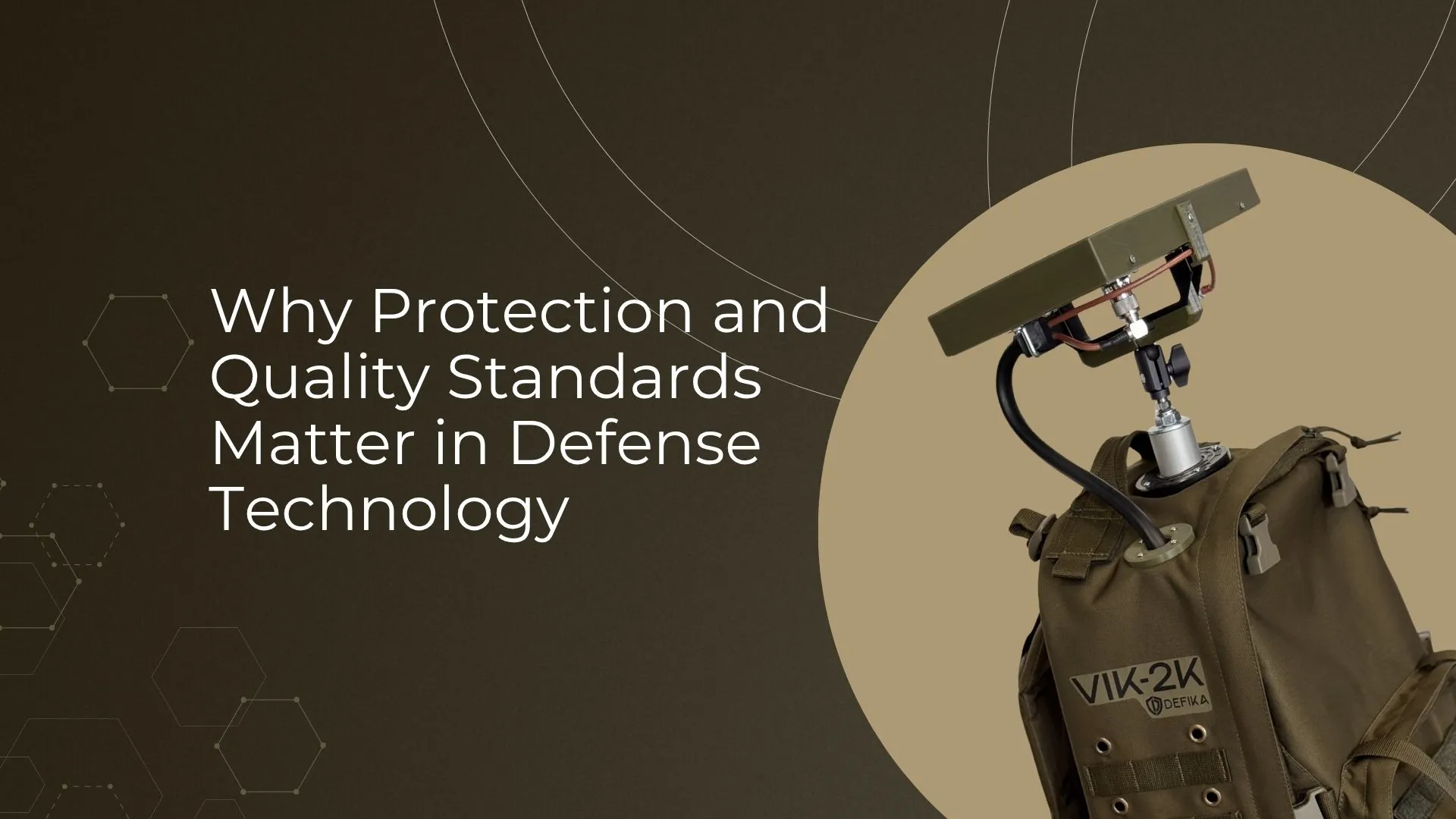
This approach was applied in the development of VIK-2K, a portable electronic warfare system in a backpack form factor, designed for individual drone protection. The system was developed with the needs of military personnel operating directly on the line of contact in mind, where mobility, autonomy, and rapid deployment often make the decisive difference.
Today, the VIK-2K backpack EW system is used as an effective counter-FPV solution and protection against other unmanned aerial vehicles (UAVs), helping to suppress command, telemetry, and satellite navigation channels. As a result, systems of this type are increasingly becoming a standard component of the equipment carried by mobile units, aerial reconnaissance teams, air assault formations, and infantry.
State Codification of the VIK-2K EW Under the NATO Codification System
The successful completion of the state codification procedure under the NATO Codification System (NCS) marked another important milestone for Defika.
As a result of the procedure, the VIK-2K EW system received an official identification number, a confirmed technical classification, and was integrated into the unified military logistics system.
For a defense product manufacturer, codification confirms that the product’s technical characteristics, purpose, composition, functional capabilities, and operational parameters have been documented in accordance with the principles of the NATO Codification System. This significantly simplifies product identification, procurement, maintenance, repair, and integration into the logistics systems of Ukraine’s Defense Forces.
For customers, it also serves as confirmation that the product meets military logistics requirements and can be supplied in a standardized format.
Conclusion
When discussing the effectiveness of modern EW systems, attention is typically paid to operating frequencies, suppression range, or transmitter power.
However, real-world effectiveness is determined by a much broader set of factors: the equipment’s ability to maintain operational performance after extended use in demanding weather conditions, the reproducibility of quality across every unit produced, and the system’s readiness for integration into military logistics.
This is why the combination of IP54, ISO 9001:2015 quality management system certification, and NATO Codification System codification forms a comprehensive approach to reliability – where each element addresses a distinct aspect of the product’s operational readiness.
If you would like to learn more about the portable VIK-2K EW system, its technical specifications, potential applications or buy an EW contact the Defika team. We will provide a detailed consultation and help identify the right solution for your needs.


